Coggins Test Results

The following is an instruction sheet on obtaining your horse’s Global Vet Link Coggins Certificate. Please call our office with any questions or concerns:

(978) 468 6307. 

  1. http://www.globalvetlink.com/ 
  2. Click on log in/sign up in upper right hand corner 
  3. When creating a new account:
    • Click on create an account a. Animal Owner account 
    • Accept terms and conditions 
    • Type in the e-mail address you gave our office when a coggins test was requested for your horse 
    • You will receive an e-mail with a temporary password and link 
    • Follow the link 
    • Type in the temporary password 
    • Create your account and new password 
  4. Click on certificates at the left side of the screen 
  5. Choose “view certificates” 
  6. Select the horse and print their certificate

*Horse owners will need to provide Parrott Equine Associates with a current/valid e-mail address in order for Global Vet Link to release coggins certificates to any person other than clinic staff.

*Horse owners will also need internet access and a color printer to print their horse’s coggins certificates. 

Equine Links


Equine

Resources,

Sites,

& Books


Disclaimer: These links, sites, or published resources are not intended to replace professional veterinary medical care. Please reach out to (978) 468 6307 or info@parrottequine.com with any questions or concerns. 

 
Website Resources:
AAEP     American Association of Equine Practitioners — Find resources and educational opportunities to help ensure your animal is supported day-to-day.
AVMA  American Veterinary Medical Association — Additional resources for pet owners large and small! Also, find resources on careers and educational opportunities.
GlobalVetLink Looking for your horse’s most recent Coggins or Health Certificate? Click here! Follow these instructions for additional log-in information.
The Horse Find a plethora of information and current newsletters on equine care and management.
MSPCA-Nevins Farm Massachusetts Society for the Prevention of Cruelty to Animals — Learn, adopt, or support a local non-profit rescue organization. 
MVMA Massachusetts Veterinary Medicine Association — Navigate to “Advocacy” for information on current legislative efforts in MA or to “Pet Owners” for resources and education.
MVTA Massachusetts Veterinary Technician Association — Click here for information on assisting veterinarians in the practice! 
NEER North New England Equine Rescue — Interested in adopting or supporting a local rescue organization? Reach out to or visit NEER North! 


 Published Resources:
 Gore, T., Gore, P., & Giffin, J. M. (2008). Horse Owner’s Veterinary Handbook (3rd ed.). Howell Book House/Wiley Pub. 
 

Harris, S. E. (2014). The United States Pony Clubs Manual of Horsemanship. advanced horsemanship, HB-A level. Howell Book House/Wiley Pub.


Hodgson, D. R., McKeever, K. H., & McGowan, C. M. (2014). The athletic horse: Principles and practice of Equine Sports Medicine. Elsevier/Saunders.


Jones, J. L. (2020). Horse brain, human brain: The neuroscience of horsemanship. Trafalgar Square Books. 


Kauffmann, S., & Cline, C. (2018). The Essential Hoof Book: The complete modern guide to horse feet: Anatomy, care and health, disease diagnosis and treatment. Trafalgar Square. 


Loving, N. S. (2006). All horse systems go: The Horse Owner’s full-color veterinary care and conditioning resource for modern performance, sport, and pleasure horses. Trafalgar Square Pub.


Swift, S. (1985). Centered riding. St. Martin’s/Marek.


Worth, M. (2010). The Horse Nutrition Handbook. Storey Pub. 

24 Hour Emergency


EMERGENCY PROTOCOL:


If you have a veterinary Emergency call (978) 468 – 6307.

If you get the voicemail, call 978-994-4581 or other number provided on the voicemail to reach the doctor on call.  

If you do not get a call back in 5 minutes, try the doctor’s number again or leave a text/voicemail.

We are available for equine emergencies 24-hours a day, seven days a week. 

Before calling us for an emergency, (THIS DOES NOT APPLY TO LACERATIONS/OPEN WOUNDS/SUSPECTED FRACTURES, CALL IMMEDIATELY) attempt to determine your horse’s basic vital signs such as:

  • Rectal temperature
  • Heart rate
  • Respiratory rate
  • Presence or absence of gut sounds and appetite.

This information will help the doctor determine the best approach to solving your horse’s ailment.

During business hours:

  • the reception staff will answer your basic questions and direct your call to the veterinarian able to help your horse
  • The pager number of the on-call veterinarian will be given on the answering machine recording.
  • Call the number given and leave a message.
  • The message must first include your phone number and briefly state your emergency.
    • The on-call veterinarian will return your call as soon as possible.
  • A delay in returning your call may mean the on-call veterinarian is attending to another horse.
    • If you do not hear from us in approximately 15 minutes please call the phone number again and leave a second message or text.

If you call the office after hours and do not have an emergency, you may leave a message for us and we will return your call during the next business day.

Please refer to our recommended first-aid kit to help prevent/manage emergencies.

First Aid Kit


First-Aid Kit


In the event of an illness, injury or emergency, you should be prepared to care for your horse until the veterinarian arrives. We recommend that you keep at least one first aid kit on hand. For those who regularly travel with your horses, we suggest keeping a second kit in your horse trailer.

For your convenience, we have emergency kits available for purchase. We can also provide singles/extras/replacements of almost all of the items listed below!

Unsure how/when to use these items? Call (978) 468 6307 or email info@parrottequine.com!
Please refer to your veterinarian before administering any medications!

Your first aid kit should include the following items:

  • Towel (bath size)

**included in our first aid kits

Foal Vaccination

Reach out with any questions or to schedule your horse’s next vaccine! 

WNV: West Nile Virus Vaccine

T: Tetanus Toxoid Vaccine

E: Encephalomyelitis Vaccine (Eastern & Western)

Combined WTE: West Nile/Tetanus/Encephalitis Vaccine

PHF: Potomac Horse Fever Vaccine (Sub Types)

FR: Equine Rhinopneumonitis-Influenza Vaccine

Strangles IN: Streptococcus Equi Vaccine (IN=Intra Nasal)

  • All boosters should be scheduled approx 4 weeks after initial dose.
  • All vaccines are series of 2 immunizations (initial and 1 booster), except Strangles IN, which has 3 (initial and 2 boosters)
  • Yearlings then go on annual schedule after their 12 month vaccines.

Not ALL foals need ALL vaccines, optional risk-based vaccines are FR, PHF, and Strangles. Core required vaccines are Rabies, WNV/T/E. Criteria for vaccination for FR, PHF, and Strangles are listed below.

  • FR & Strangles: should be vaccinated if traveling, showing, living at a barn with large numbers of horses traveling, showing. Risk is coming into contact with large numbers of horses other than those kept on the farm. 
  • PHF: should be vaccinated if there is standing water on or near the property. Mayflies that breed in and around standing water transmit the disease.

Additional learning:

Foal Vaccinations (Merck)

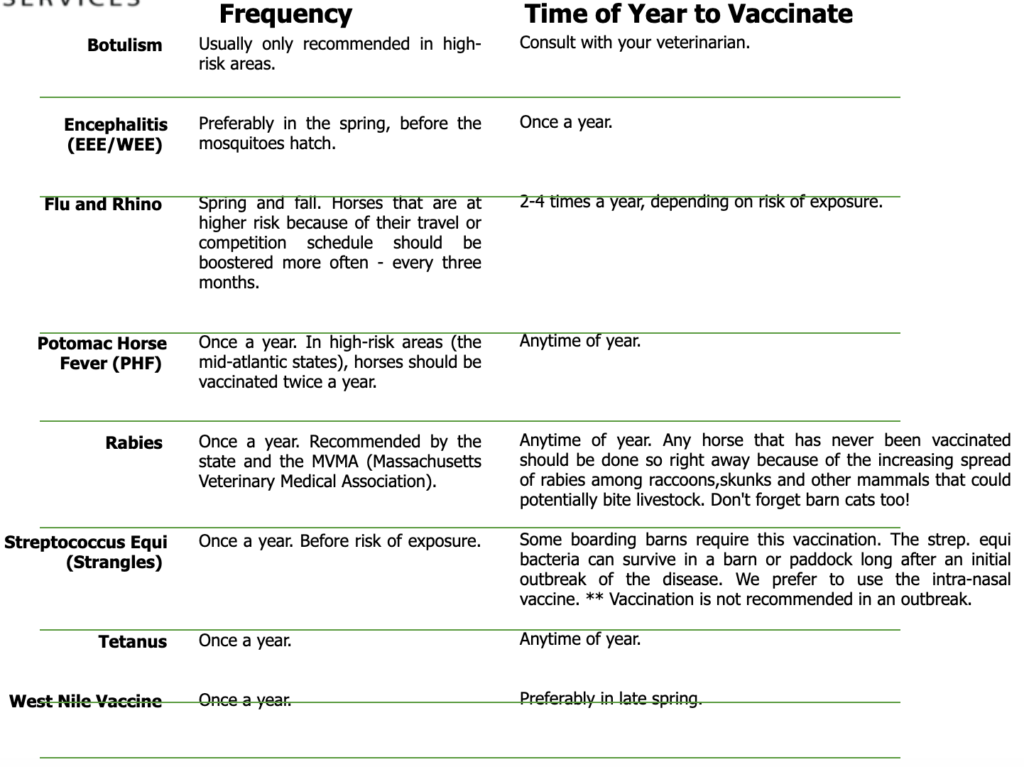
Mature Horse Vaccination Schedule/Recommendations

Pregnant Mare Care

The normal equine gestation period is 344 days, although this may vary depending on the mare.

Obstetrical Ultrasounds:

  •   Day 14 – 16 post breeding
  •   Day 33 – 35
  •   Day 60 – 65

  Rectal Palpations:

  •   5 months
  •   8 months

  Vaccinations:

  •   Rhino vaccine at 5, 7, and 9 months
  •   All other vaccines at 10 months (+/- Rabies)

Deworming:

  • Alternate between Pyrantel Pamoate (Strongid Paste) and Ivermectin Paste every 6-8 weeks.  
  • At 10 months deworm with Ivermectin Paste.  
  • DO NOT use Moxidectin (Quest), Ivermectin/Praziquantel (Equimax), or Fenbendazole (Panacur Power Pack) during pregnancy.

Foal IgG Test:

The foal should have an IgG test at 12 – 24 hours old. At this time the mare and foal will be examined to ensure they are in good health and a vaccination schedule for the foal can be discussed with the veterinarian.

Vaccinations


Vaccination Schedule and Recommendation


WHAT TO DO IF YOUR HORSE HAS A REACTION

All vaccines are tested carefully for safety before they are made available for horses, but some horses are more prone to having a reaction to shots than others.

Potential reactions and what to do:

  • If your horse seems to have a stiff neck or has lost interest in his food, keep him warm and comfortable and keep an eye on him.
    • A certain amount of walking around and stretching may make him feel better, but don’t turn your horse out if he’s going to gallop around and break a sweat.
    • If his neck is really stiff, you can apply a hot towel to that area and hang up a hay net to make it easier for him to eat.
    • Check his temperature.
  • If your horse is unusually sore after a vaccination or is running a fever, consult your veterinarian to see whether it’s advisable to give him some Bute (Phenylbutazone) or Banamine (Flunixin Meglumine).
  • Most reactions to vaccinations are mild and clear up on their own within a day or so.
  • Severe reactions to vaccinations are rare, but as with any signs of serious illness, call your veterinarian immediately.

SCHEDULING VACCINATIONS TO AVOID REACTIONS

Although up to four of the vaccines listed here can be given at the same time, five or six shots in one day is too many. We recommend that you split up your horse’s shots to minimize the risk of a reaction.

In any case, please don’t wait until the day before a show or a long trip to vaccinate your horse. The added stress of shipping and competing right after vaccinating can make your horse more vulnerable to illness.

It takes approximately two weeks to gain maximal immunity to the disease you have vaccinated for. Plan your riding schedule so you can give your horse the day off after the vaccinations.

Preventative Care


KEEP YOUR HORSE HEALTHY YEAR-ROUND!


The list below is not exhaustive, please reach out to our office with any questions or concerns!

Basic Recommendations:

Annual Wellness Examination

An annual physical exam is recommended to assess your horse’s overall health and address any questions or concerns you may have. Subclinical issues commonly go undetected, and these can be identified and addressed before they cause a problem.

Coggins Test

A blood test for Equine Infectious Anemia (EIA) is required for horse shows and travel across state lines. A Coggins test typically takes about one week for the laboratory to report the results, but can be obtained sooner upon request.  If results are needed within 24 hours a special test can be done!

Most states and horse shows require a Coggins test annually, though some may require every six months. Research and meet the requirements of your destination well in advance of your travel date to avoid delays in test results. Or, reach out to us for help!

We are now using Global Vetlink for Coggins tests and Health Certificates. A step by step process on accessing Coggins can be found here.

Dentistry

A horse’s teeth continually grow and develop sharp edges with regular wear. These edges need to be filed down in order for your horse to comfortably accept the bit and to properly chew feed. Horses need regular preventive dental maintenance every six months to one year.

Deworming

Horses can pick up tag-along parasites easily. Preventative and reactive deworming is important! Find the current deworming recommendations and protocols at the link above.

Concerned your horse might have worms? Need a negative fecal result before your horse travels? Schedule a fecal test with us today!

Sheath Cleaning

Male horses require routine sheath cleaning 1-2 times per year to maintain good hygiene. If you’re not comfortable performing this procedure yourself, please contact our office.